


From the simplest virus to complex human life processes, they are all based on protein structures, and proteins are composed of more than 20 different amino acids.
At the beginning of the last century, physiologists Bayliss and Starling of the University of London discovered a chemical substance in the animal gastrointestinal tract that could stimulate the secretion of pancreatic juice and named it "insulin."
This was the first publicly disclosed active peptide substance, composed of amino acids but distinct from proteins, yet possessing specific biological activity under certain conditions. Scientists named it "peptide" - natural active substances formed by the connection of two or more amino acids through peptide bonds.
Overview: Advantages of Peptide Products
Peptides applied in cosmetics are generally small molecule peptides composed of two to ten amino acids.
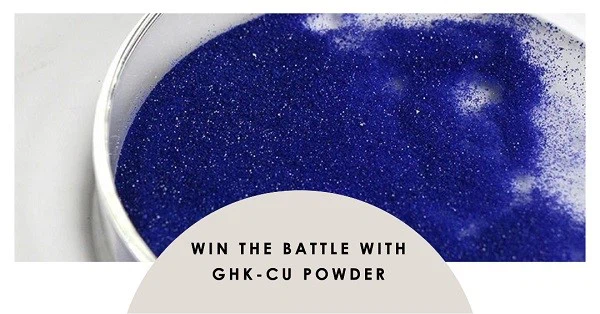
GHK-Cu Powder - The "Blue" that Defies Description
It appears as an indescribable shade of blue, resembling ink blue yet with a hint of purple-blue, possessing a mysterious and captivating color.
Blue Copper Peptide has consistently ranked in the top 10 of popular ingredients, with various internet celebrities touting its benefits and various brands incorporating it in suitable quantities to use it as a marketing gimmick. Today, let's delve deeper into Blue Copper Peptide!
What is Blue Copper Peptide (GHK-Cu)?
Blue Copper Peptide, also known as Copper Tripeptide-1 or GHK-Cu, is a rare fragment found in human proteins, primarily present in proteins associated with inflammation, such as collagen, platelet response proteins, fibrinogen alpha chains, pro-collagen, and interleukin-4. GHK is one of the few small peptides in the plasma, present at around 200ug/ml at the age of 20 and decreasing to 80ug/ml at the age of 60.
GHK's most notable characteristic is its formation of a complex with Cu ions, known as GHK-Cu (Blue Copper Peptide). GHK functions in repair and regeneration as a complex with divalent copper ions.
The human body and skin have many essential enzymes that require copper ions, playing roles in connective tissue formation, antioxidant defense, and cell respiration. Copper ions also have signaling functions, influencing cell behavior and metabolism. For instance, an adequate amount of copper ions serves as a signal for stem cell proliferation and tissue repair. GHK also helps reduce the concentration of free copper ions, preventing oxidative damage.
Developmental History of Blue Copper Peptide
Since the 1930s, copper has been recognized as an important nutrient. Research has revealed that copper plays a key role in enzyme systems necessary for tissue repair, blood vessel formation, wound healing, and inflammation reduction. Copper is now considered crucial for normal repair and healing processes.

1970s: A Significant Breakthrough
1973: Dr. Pickart first isolated GHK-Cu, a tripeptide substance that was discovered to have similar effects on aging and young tissues, and subsequent research confirmed its sequence as glycyl-L-histidyl-L-lysine with a strong affinity for copper ions, forming the GHK-Cu complex.
1985: Discovery of GHK-Cu's wound healing function.
1986: ProCyte Corporation was established.
1999: ProCyte established the NEOVA brand, applying copper peptides to tissue repair, wrinkle reduction, hair growth, and other treatments.
From its discovery in 1973 to its application in cosmetics in 1999, copper peptides have been in use for over 30 years, with well-established safety, efficacy, and reliability.
Structure of GHK-Cu
The amino acid sequence is glycyl-L-histidyl-L-lysine-Cu(II). Under physiological conditions, GHK-Cu can form binary or ternary structures.
INCI Name: Copper Tripeptide-1
Other Name: GHK-Cu
CAS: 49557-75-7
Molecular Formula: C14H24N6O4
GHK-Cu Powder has become increasingly prevalent in the market recently. Even if it is included, it is rarely mentioned at high concentrations due to cost considerations. The most straightforward way to assess its concentration is by examining the color. Some colors are achieved by adding ingredients like turquoise, so it's essential to check the ingredient list before purchasing.

To summarize the benefits:
1. Assists in the generation of key skin proteins such as collagen and the dermal matrix (the most important benefit).
2. Restores skin's repair capabilities and reduces skin damage.
3. Significantly increases keratinocyte proliferation, enhancing skin thickness.
4. Promotes blood vessel growth, increasing skin oxygenation.
5. Reduces blemishes, photodamage, and pigment deposition.
6. Improves skin elasticity and reduces fine lines and deep wrinkles.
Operational Requirements
1. While Blue Copper Peptide offers excellent benefits, it also comes with specific operational requirements:
2. Avoid using it with acidic substances (e.g., fruit acids, retinoic acid, high-concentration water-soluble vitamin C). Capryloyl Hexapeptide-12 (CHA) cannot be used as a preservative in copper peptide formulations (it cannot be combined with aqueous PHL and oil-based OEL).
3. Avoid ingredients that may form complexes with Cu ions. Example 1: Palmitoyl Pentapeptide-4 has a structure similar to GHK, so it can compete with copper ions and change the solution's color to purple. Example 2: EDTA is sometimes used in formulations to remove trace metal ions, but it can capture copper ions from GHK-Cu and change the solution's color to green.
4. Mix GHK-Cu solution at temperatures below 40°C, adjust the pH to around 7, and then add the GHK-Cu solution. Both excessively high or low pH levels can cause GHK-Cu to change color.
5. When color changes occur in the solution, try mixing the GHK-Cu solution with different ingredients in the formulation, observe color changes, identify the cause, and consider replacing that ingredient. For example, if there are ten ingredients in the formulation and color change occurs when mixed with copper peptide, divide the formulation into two groups, A and B, and mix each group with copper peptide separately. If group A causes the copper peptide to change color, mix each ingredient in group A separately with the copper peptide to identify the ingredient responsible for the color change.
As one of the most professional GHK-Cu Powder manufacturers and suppliers in China, Qyherb is featured in good service and competitive prices. If you would like to wholesale, please contact us at info@dnbiology.com.